Implant types
Examples of implant types
From a few single implants to the restoration of a full arch — some of the most common solutions, including complex cases of severe bone loss. Every plan is built individually; what is shown here are examples only.
A full arch on four to six implants
The method known as All-on-4 or All-on-6 — when all the teeth in a jaw are missing.
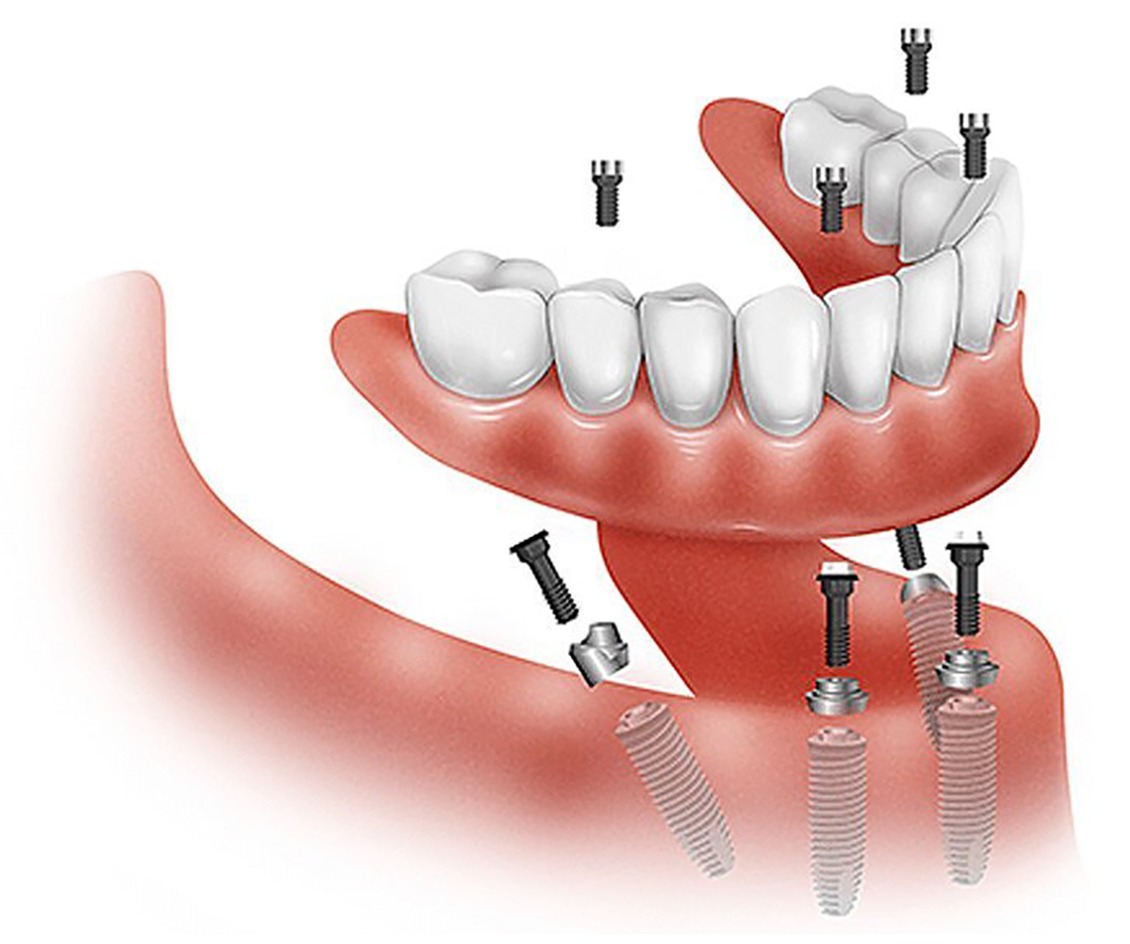
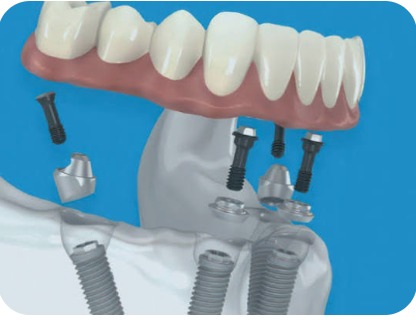
When all the teeth in a jaw are missing, a full arch of fixed teeth can be placed on just four to six implants. The front implants are set on a vertical (axial) axis and the back ones are tilted at an angle, to anchor them where dense bone remains and to widen the bridge's support base front-to-back. In the upper jaw the tilt usually lets them bypass the maxillary sinus, so in many cases no sinus lift or bone graft is needed; in the lower jaw it is used to bypass the nerve canal and the mental foramen.
'Multi-Unit Abutment' connectors are fitted onto the implants, available both straight and pre-angled at various angles — for each implant the connector matching the angle it was placed at is chosen. The connectors compensate for the difference between the implant axes and create a shared insertion axis, so a single continuous bridge can attach to all of them. At the same time they move the connection point above the gum line — so the screw channels are accessible, the gums are not disturbed at each removal, and the dentist can remove the bridge and refit it easily for a check-up or maintenance.
The bar that holds it all
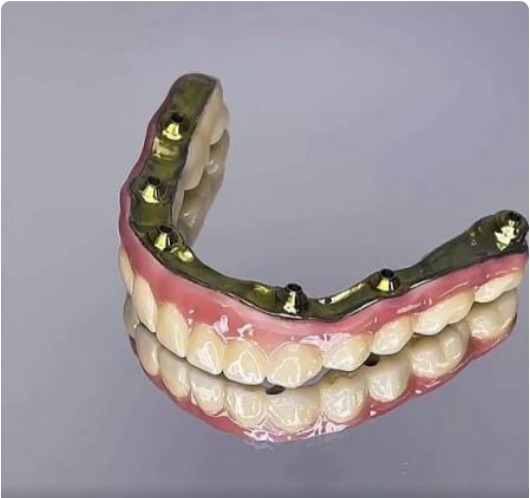
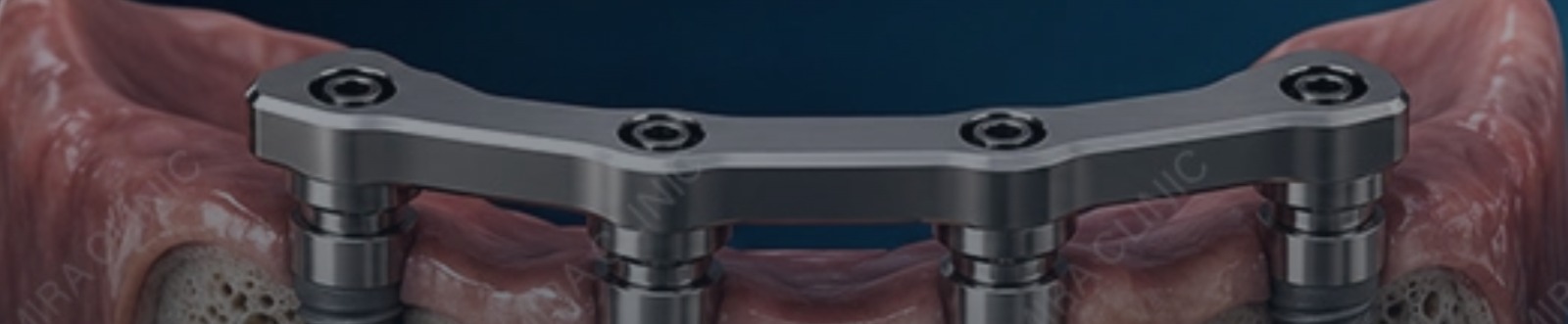
In a full-arch restoration, a structure based on a titanium bar is sometimes built: a bar milled by computer (CAD/CAM) from a single titanium block, according to a precise digital scan of the implant positions in the mouth, joined to all the implants together. It gives the bridge a strong, even foundation, links the implants into a single unit and helps spread the load between them and reduce stress concentration on any single implant. The final work is built over it.
The visible part is milled by computer from zirconia over the bar — the teeth together with a pink gingival portion that restores the height of the resorbed tissue and returns the correct proportion to the smile. The metal base is completely hidden.
The goal: teeth that look natural
The visible part is made from zirconia (zirconium dioxide) — an exceptionally strong material, resistant to fracture and stable in the mouth for years, which in its more multi-layered and translucent generations transmits light in a way similar to a natural tooth. The colour, shape and length are decided together with you: the shade is chosen using a shade guide (VITA), and before final production the look can be adjusted and approved at a try-in stage. The goal is a smile that blends naturally into the face — what many call a 'Hollywood smile'.
Complex cases: severe bone loss
Advanced dental-implant solutions for cases of severe bone loss in the upper jaw. Even patients who were once told an implant was not possible can often have a solution found for them — subject to an examination, a CBCT scan and a personal diagnosis.
- An answer even in complex cases of severe bone loss
- Usually without a bone graft
- Shorter treatment times compared with a route that includes a bone graft
- Full, aesthetic and functional restoration
Important to know
Zygomatic and pterygoid implants are an advanced surgical procedure, usually performed under general anaesthesia or deep sedation by an experienced surgeon. As with any surgery there are risks — including sinus inflammation, swelling, and temporary altered sensation in the area. Suitability for this route is determined only after a CBCT scan and an examination, with a full explanation and the signing of an informed-consent form.
Three advanced implant types
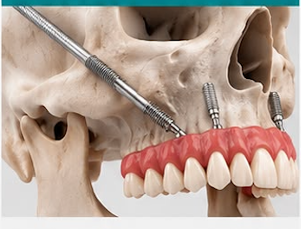
Zygomatic implants
Especially long (about 30 to 55 mm), inserted from the upper jaw upward along the sinus wall to anchor in the cheekbone (zygoma). This gives a stable solution even when there is not enough bone in the upper jaw.
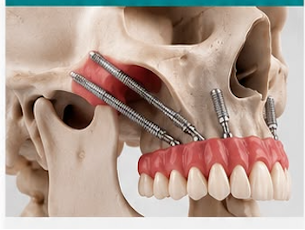
Pterygoid implants
Inserted from the posterior region of the upper jaw at a back-and-upward angle, and anchored beyond it — in the pyramidal process of the palatine bone and the pterygoid process of the sphenoid bone, an area of dense cortical bone behind the sinus. This gives the bridge genuine posterior support, eliminates the cantilever at the end of the bridge, and removes the need for a sinus lift or a bone graft in this area.
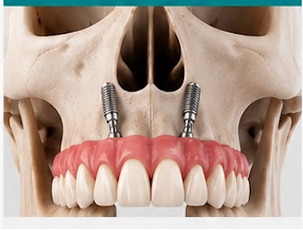
Nasal implants
Placed in the anterior region of the upper jaw and anchored in the dense bone around the nasal aperture — the piriform rim and the nasal floor (Trans-nasal / Piriform). They provide anterior anchorage when the bone in the area has resorbed and standard implants are not possible, and are usually combined with zygomatic or pterygoid implants for a full-arch restoration.
The treatment is carried out at a certified, modern clinic in Georgia, whose official representative in Israel we are, by an experienced surgical team. We accompany you at every stage — from the diagnosis in Israel, through the treatment itself, to the support and follow-up after your return.
How we approach it
- Diagnosis with a three-dimensional CBCT scan
- An experienced team of specialists
- Personalised digital planning and a surgical guide for implant precision
Even if you were told an implant isn't possible
Send us a CT/CBCT scan from the past year, or a panoramic X-ray and status. If you don't have recent images, get in touch and we'll refer you to an imaging centre at special prices. The scan you take there is yours, and does not commit you to us in any way. Once we have the images, we can offer you a personalised treatment plan — at no cost and with no commitment.